Tuesday, 6 August 2019

The Mystery and Magic of Easter Island

Oh. My. Goodness. We are in Easter Island and it's incredible!

I'm going to start from the beginning. Like three million years ago..... A volcano, then another, then another erupted in the middle of the Pacific ocean, miles from anywhere. Offshoot eruptions filled in the gaps between the main volcanoes, forming an island. They stopped erupting about 10,000 years ago. Today the coast is still very wild and rugged.


Jump forward to about 800AD and we find a group of about 200 Polynesians, probably from what is now French Polynesia, crowded into a large double canoe, looking for land. They are great sailors and navigators and make their way for about 3,000kms to this speck of land and settle in. The island is just a pimple on a sea of blue - only about 20kms long on its longest side.

Life is good for the new inhabitants and they multiply at a great rate. Polynesians at that time believed greatly in mana, a person's spirit or aura. They believed that when someone powerful died, usually a chief, their mana could be preserved by building a statue dedicated to them. These statues were called moai (pronounced mo-eye). If that moai overlooked their village, then the old chief's mana would protect the village. And thus began the era of one of the most astonishing building feats in human history.

A quarry was found where the stone was soft and (comparatively) easy to carve. Teams of carvers spent one to two years carving a single moai. As time went on, these moai got larger and larger until some measured 10 or metres high and weighed 80 tonnes. These were raised on platforms all over the island (I'll come to the 'how' later). The results were spectacular.

Tongariki, the largest collection of  moai now standing on the island.


The statues are quite similar but there are always subtle differences between them.


Some moai have a top-knot on their heads. It is thought that this represents the hairstyles they wore. These top-knots were carved from red scoria, sourced from a different quarry. Also note the long fingers at the bottom of each moai.


At another site called Anakena, more of the statues had top-knots. This site was located right in front of one of the island's two beaches. The old fishing villages used to be located where canoes could access the sea.


Our first trip out was with a guide. This was a great way to get a lot of info before exploring further by ourselves. Gina was a local with a lot of historical knowledge. She was great! John and Gina are standing beside an old crematorium at Akahanga.


After that. we hired a little Suzuki Jimmy and drove around ourselves. It was a great way to go.


There was one separate statue at Tongariki, nicknamed the Travelling Moai. This statue was lent to Japan, a country that has a fascination with Easter Island. In return, they paid to rebuild the entire complex at Rongariki. It was a huge project that took years and cost a fortune but they were true to their word - they rebuilt the complex and returned the moai.


We ended up visiting this site three times! It was really special. 


One day we had the whole place to ourselves.


As we drove out, a rainbow appeared over the complex. Amazing!


One of the big questions about the Easter Island statues is how on earth were they moved? The Polynesians didn't even have large animals let alone machinery. There are many theories - they could have been rolled on logs. But when the old people were asked how the statues were moved they always said, "they walked". Some archaeologists recently came up with a new theory. The statues were carved in such a way that they had a forward-leaning centre of gravity. The archaeologists discovered that if you tied ropes around one and started rocking it, it actually moved forward and "walked". Some of these statues were moved many kilometres so, whatever the method was, the achievement was astonishing.

There are about 1,000 moai on the island and almost none are under cover. They are a few hundred years old and are showing signs of erosion. The island is very windy and fairly wet. It's hot in summer and sea spray is everywhere. All of this is bad news for the magnificent statues that are carved out of soft rock. It's only a matter of time before each one becomes an indistinguishable blob of rock. Check out this one that had been left lying on its back near the sea.

Sometime by the early 1700's, overpopulation began to be a problem. When the islanders had first arrived, Easter Island was covered in trees, mostly palm trees. There were now no trees left. Food began to get scarce and fighting broke out between the various tribes. As the fighting got worse, they began to not only steal their neighbours' food but they toppled their moai as well. In a few short years, all the moai fell. The magical, mystical statues were now just rubble on the ground.

At Akahanga the statues have been tipped onto their faces while their red top-knots lie nearby.


The quarry, called Rano Raraku, was a remarkable place where the nearly 400 moai in various stages of completion, lay or sat where they were left. As we approached the quarry several moai lay on the ground. They either broke while being transported or were abandoned during the fighting.


There were many stages to making the statues. First, the front and sides were carved while the body was still attached to the bedrock. When that was done, it was cut from the bedrock then slid down the hill into an awaiting hole. The statue would stand upright in this hole to allow the back of it to be carved. Many moai were in their holes when the quarry was abandoned. This has left an eerie scene where hundreds of half-buried moai are scattered along the lower slopes of the old quarry. It's magnificent.


You will have noticed by now that the statues are all very similar. The heavy brow, ski-ramp nose, thin lips and long ears are evident on all the main moai however every now and then one is completely different. This guy overlooks one end of the quarry. He is kneeling, something moai never do, and his face is different. It is thought that maybe he was a revered master carver but nobody really knows.


The top-knot quarry was also abandoned with work partly completed. These top-knots were ready to be transported when all work stopped. They still lie where they were left.


The people weren't just moai builders though. They also carved figures into rocks. These usually represented canoes, fish or bird-gods (more to come on this later). Again though, nothing is protected. The rocks were completely exposed to the elements and you could already see a lot of erosion.


This rock is famous for having the largest petroglyph (rock-carving) on the island. The curved lines on this are a huge double canoe. But look at those puddles! There is no attempt to keep the rain off it.


There is actually one site that has been covered, although not for the reason you'd expect. This one is next to the modern quarry and they thought they should do something to protect the three moai here from the rocks being flung from the quarry during blasting! These moai were already badly eroded though.


One place was set up to show us how the houses were made. The houses of the chiefs were in the shape of an upturned canoe. The bases were edged with basalt rocks with holes carved into them. Poles were fitted into these holes and a roof frame constructed on these.


The ancient people also had areas of religious significance. Here, a circle was where ceremonies were held, right in front of the moai and their fallen top-knots.


Horses and cattle roam freely all over the island. This is all very lovely to see but horse and cattle hooves wreak havoc on platforms and fallen moai.


The moai originally had coral and scoria eyes in them. Only one has ever been found. It's now in the museum.


The moai were always placed on platforms and these platforms were amazing creations in their own right. Some were huge and contained tonnes of rocks. One was even carved so the rocks fitted each other perfectly. 


Back to the island's history, in an effort to restore order after all the rioting and raiding, it was agreed that there would be what was called a birdman competition each year. Each tribe had one representative who had to race the others down a 300 metre cliff, swim 2kms to an island, collect a bird egg and return that egg unbroken to their chief. The winning tribe got to rule for the next year.

This competition was held at the very tip of the island. Everyone moved there for a few weeks to prepare for the race. They built houses of stone here because the wild winds wouldn't allow thatch to stay in place. These have now been restored.


The second island is the one they had to swim out to after climbing down the cliff. Apparently people died from falling from the cliff.


Directly behind the birdman village was a huge crater where they would no doubt have sourced a lot of their fresh water from as there are no rivers on the island.


In 1862, tragedy struck the island when Peruvian slave traders came calling. From a population of around 12,000 they took about 1,000 people for slaves. A catholic priest later managed to get over 100 of them sent back to Easter Island. Sadly, most of them died en-route and only 15 made it back to the island. Those 15 came back with unwanted baggage though - smallpox. Within a few years all but 111 islanders died. From what was once a spectacularly successful society, this is all that was left.

The next 100 or so years saw little improvement. The island was annexed by Chile who subsequently leased the whole island out to a sheep farming company. The islanders were rounded up and forced to stay in one town while the company took over the island. It wasn't until the 1960's the natives were given any say in how their island is run. Today the place is pleasantly ramshackle but on an upward trend.

Not all the features on this island are man made. These lava tubes were cool to explore.


In a few places the ceiling had collapsed, leaving an open hole to the sky. Lots of plants grew here and we found this huge beehive!


That evening we watched a magnificent sunset from a great restaurant on the shore.


After that, we went to see a traditional dance show. Unlike the dancing we saw in French Polynesia, this was put on for tourists but came highly recommended. Well, I didn't know what I was in for! Strapping, fit young men, wearing nothing but g-strings, feathers and tattoos gyrated their near-naked bodies around right in front of us! It was more like the Chippendales than a traditional dance. But who was I to complain?


Oh yes - there were women too!!!


The funny thing was, we had seen this sign in the street earlier. It means "hair removal". Sitting as close as we were to these performers, there's no doubt they had visited this shop!


Around the town we saw some other interesting sites. Isn't "Danky Cheeskater" the coolest ice-cream name you've ever heard?


For such an isolated place, the food was excellent. There were heaps of vegetables! The local specialty was empanadas, like pasties. They were great! 


Unfortunately, everything had to get flown or shipped in and it was all so expensive. A meal each cost us about $70 Aussie dollars. There is no proper port here. Goods are unloaded from the ship onto small boats to be brought to shore. We heard that one time there was a ship with the next load of gas bottles on it that sat offshore for a month waiting for the seas to be calm enough to unload. There was a shortage of gas across the whole island.

Chickens and roosters were everywhere. I love chooks and the ones on this island were all so pretty!


We met a Japanese guy called  Naoshi. He recently ran for the position of mayor in his home town and lost. This trip was a holiday for him to get some balance back in his life I guess. He had a really funny habit of making noises during a conversation. For example, a conversation might so like this: Me: Did you visit the quarry today? (Naoishi: mmmmmMMMMMmmmm!). Weren't the statues amazing? (erggGGHHHHHhhhh!). It rained when we were there (ooeeeRRGGGHHHhhhh!) It was still fantastic though. (hmmMMMPPPHHHhhh!). I really can't describe it but it was so funny!

We met other good people here including an English couple who were travelling araound South America in a motorhome. She had MS so it was a great way for them to go. They had led interesting lives - both were in the army and lived in the Falklands after the war. 

We also met a Kiwi couple. Together with them and Naoshi, we saw the Kevin Costner-directed movie, "Rapa Nui". (Rapu Nui is the local name for Easter Island.) It was interesting to see the movie while we were on the island where the story was set but we could see why it was a $20 million flop. Noashi continued to gurgle and hmmphh his way through the movie.....

The differences between French Polynesia and here were striking, largely due to the difference in climate as well as the Spanish influence versus the French influence. Gone were the colours, the flowers, the bright clothes and the obesity of French Polynesia. The people of Easter Island were friendly but perhaps not as much as those of French Polynesia.

We also had a bit of a hiccup here when we learned that Courtney had her Irish passport and bank cards stolen from her bag in Buenos Aires. It has been a big headache for her - and for all those at home that helped her - but she's just about got everything sorted now.

The last site we visited was the one closest to town called Tahai. They have replcated the eyes in one of the statues here. It looks a bit strange.


On our last night we watched the sun set behind these amazing statues. Many other people did the same thing. It was wonderful and a fitting end to our stay.


So that's it for now. We're off to South America and will be with Courtney in a few days!

Ciao!
Heather and John


Thursday, 1 August 2019

Rangiroa, Fakarava, Tahiti and Moorea.

For those of you that read our travel blog because we visit challenging and off-the-beaten-path destinations, you might as well just skip this post. We've been lolling around in a tropical paradise! We thought this part of the trip would be a cultural adventure, but really, it's become a holiday and not much more. So feel free to not read this post, but come back for the next one when we leave French Polynesia and go to Easter Island. Ooohhh, that should be interesting!

Anyway, we arrived in Rangiroa, another of the coral atolls of the Tuamotu archipelago of French Polynesia. Because we had left our bookings for this trip so late, we now had to stay in two different accomodations on each island, just in an attempt to get rooms. Our first accommodation here was a sort of resort but it was hardly luxurious. We had a shocking bed - an old spring mattress that sagged seriously and made boinging noises every time we rolled over. On the plus side, the place was located on the beach and had wifi. The wifi was important becuase the Tiges were playing Port! There was poor internet right through the resort but good internet outside the main office. There was a wooden table and chairs near the office with an old palm frond roof that was missing all the fronds in the centre. The game was at night time and it was raining. The only way we could watch the game and protect the computer from the rain coming through the roof was to put an umbrella over the computer. What a classic way to watch a game. And we won!


John went diving again and saw lots of sharks and dolphins - the area is famous for them. I went snorkelling in front of the resort but it was nothing special.

We explored the area by bike. The wind was consistently very strong on the seaward side of the motu but calm on the lagoon side. The wind made a significant difference to the effort required to pedal the bikes!

One day we had lunch at a great little cafe overlooking the famous pass. Like the pass at Tikehau, the water funnelled between two motu. Lots of sharks and larger marine life live here.


We took a snorkelling trip to the pass. We were joined by a lovely French family who we later stayed in touch with. The first stop was out on the seaward side, looking for dolphins. Within five minutes I was feeling a bit seasick as we bobbed around on one to two metre waves. Suddenly we saw the dolphins near us and jumped in.

This photo is the result of trying to take a photo while being thrown up and down waves!


The dolphins came quite close but didn't stay long. It was so cool that we could hear them in the water too.


We clambered back into the boat in the rough water (it was almost as difficult as getting back into the dive boat at Tikehau) then moved on to the pass. We were dropped off at one end of the pass and the boat followed us through. The current was quite strong and we whizzed along quickly. There was no time to stop and look at anything!

We saw some grey reef sharks.


We drifted right through the pass and out to a small island. The waters around here are called "The Aquarium". The fish life was striking but we shared the main aquarium area with five or six other boats.


After the first few days we moved to a small pension with only four rooms and it was great. It wasn't on the beach and was quite simple but the owner was lovely. I came down with a tummy bug, which luckily didn't last too long. I was surprised to pick this up as Polynesia is really clean. It's nothing like Asia in that respect. We were forced to just take it easy for a day, something we rarely do. It was fun!

Once I was better we snorkelled outside the big resort near us - the Kia Ora. Check out the overwater bungalows. That's John snorkelling in front of them.


Again, some of the fish were very friendly. They were obviously hoping for food.


The French family that we met on the snorkelling trip were staying at the Kia Ora so we went there a couple of times for drinks and meals. Yanick, Angeline and Manon were lovely and we had a couple of enjoyable evenings with them.

We then flew to the next atoll, Fakarava. Our first accomodation here was the most expensive of the trip. We arrived and thought we had landed in heaven. We had a nice bungalow right on the water - with aircon! - and this was the view that greeted us.


The snorkelling was ok. Once again, there were only outcrops of coral, not a reef to speak of. I'm a bit smitten with the organic shapes of the things in this photo. I'm not even sure if they're a coral. 


While I was snorkelling, I caught a glimpse of what seemed to be quite a large shark nearby although visibility wasn't great at the time. My heart might have pounded a bit. A startled word might have slipped up my snorkel!

I snorkelled back into the beach to find John ensconced at one of the tables in the water. How cool is this?


I wandered up to the bar and came back with sunset drinks. Awesome!


We sat with our feet dangling in the water, drinking our drinks and watching the sunset. Sensational!


The sun had just set when John saw a shark approaching us, then another. They were huge! They certainly weren't reef sharks.


One of the sharks slowly circled around us. We both instinctively pulled our feet up out of the water. Wow!


I looked out of our window early the next morning and found this ball of fluff fast asleep on our balcony. There are lots of dogs and cats on the islands.


Before it got too hot, we went for a walk, We were staying near the main town, which was still very small. It was really interesting. First we found a church. It's the only church I've ever seen where the light fittings and banners are all made from shells! They use shells to decorate everything here. Each place we stay at gives us a shell necklace. We're getting quite a collection!


A small container ship was pulled in at the port and everyone was busy unloading water, fuel and groceries. A brand new supermarket was located at the port and the fresh fruit and vegies had just come in. There was quite a crowd gathered around to grab them as they were being unpacked. I know we have struggled to get fresh fruit and vegies but I had understood that the locals grew their own. I guess that they can't grow everything. It was a good insight to see how reliant people on the atolls are on supplies coming in on the ships.

Fakarava was the neatest of the atolls we visited. There were few ramshackle places and more houses that were neatly painted. They were all very scenic though.


We moved accommodation again. This one was not flash like the last one but was again located right on the lagoon. It was all perfect except for our terrible mattress. It was another old inner-spring mattress where every spring could be felt. It also smelled. Ewww. 

Again, we had half-board at our accommodation. This meant we got breakfast (basic) and dinner which was always three courses, two of which were usually fish. Again, I just said I don't like raw fish and I was able to eat everything. Some of the fish was delicious!

There were two restaurants nearby for lunch and they were both great and overlooked the water. It was all pretty perfect really!


That night at dinner, a French guest pulled us aside to show us something. Just in front of the kitchen, in about 40 cms of water, were five sharks fast asleep on the sand! 


When the meal was finished, the staff tipped the food scraps into the water. The sharks very slowly woke up and started eating. They were happy to slide all over each other to get the food. In such shallow water, they sometimes had half of their bodies out of the water!

I did some research and learned that these are Nurse Sharks. They're also called Sleeper Sharks due to their ability to sleep while lying still. Most sharks have to continually move. They are considered to be relatively harmless - there have 'only' ever been 44 attacks on humans reported. Most of those were because they were provoked and none were fatal. I felt more comfortable about them once I understood them a bit more but it wasn't until the last day that I would snorkel on my own!


We rented a scooter one day to explore the island. It really didn't take that long! We look like we've got billiard ball heads.


We opted for another sunset drink back at our first accommodation for our last night so we used bikes from our current accommodation to get there. I love that they had official parking space for bikes!


It was our last morning here and, to be honest, idyllic as the location of our accommodation was, we were relieved to get away from the horrible bed in this place. We were sent off in spectacular style though by a gorgeous rainbow.


We did a bit of a postie's run on the plane back to Tahiti, passing more atolls on the way.


We rented an apartment in Papeete this time and it was fantastic to have a bit of space - and a mattress without springs!

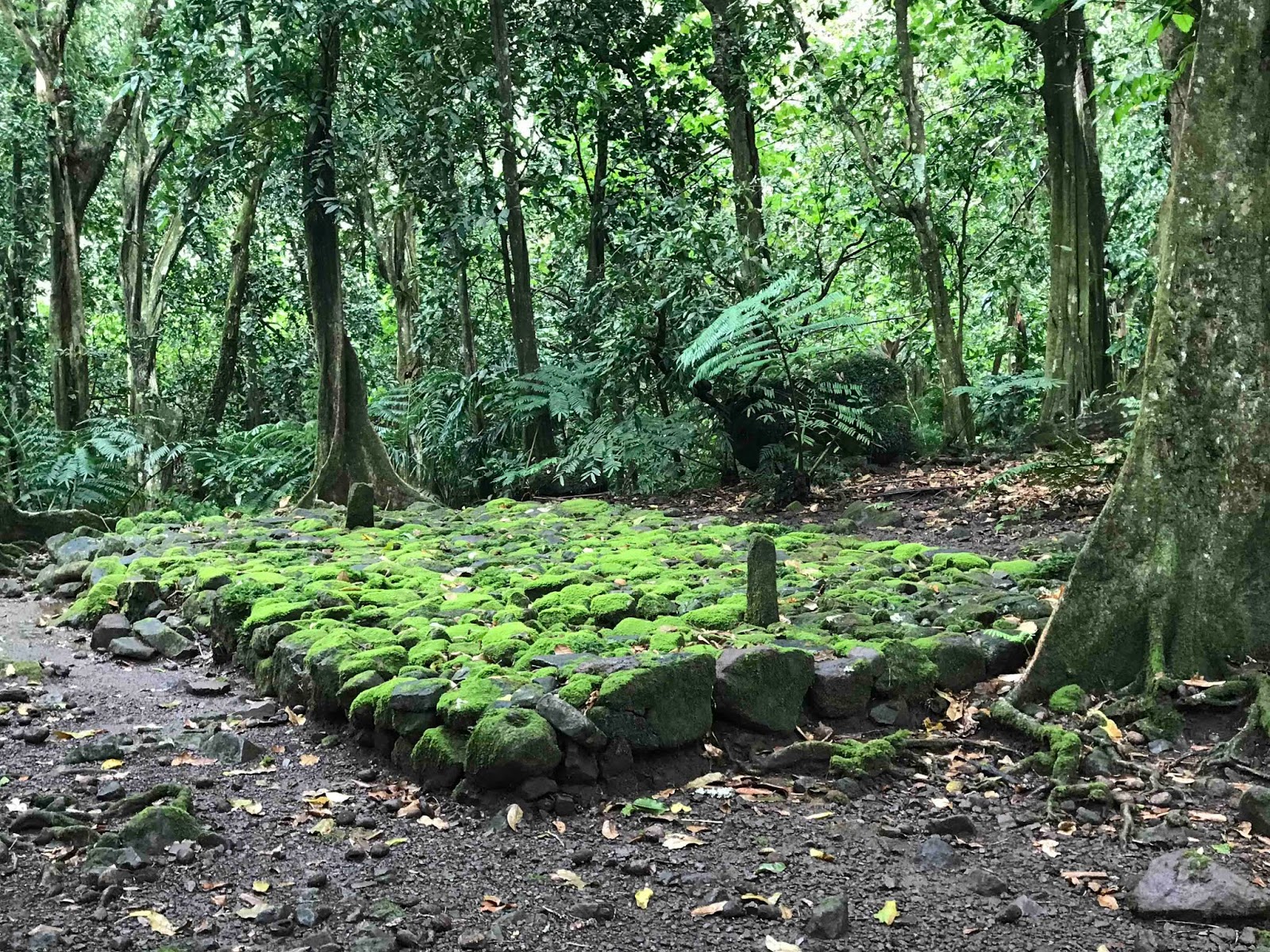
We only had two days here so on our first day we caught a ferry across to Moorea. This island was beautiful - lush, green and rugged. We hired a car and visited our first marae, old places of ceremony. They usually consisted of areas marked with stones. Their locations in the beautiful jungle were spectacular.


At a viewpoint we overlooked two bays. The one on the left was the one that Captain Cook anchored the Endeavour in.


The ferry trip back was quite crowded. I managed to grab a couple of flower garland shots.


Back on Tahiti we hired another car the next day and drove around the island. We visited more marae, again in beautiful settings.


There were some caves near the road. This one was raining on the inside when it was dry outside!


Another cave in a beautiful setting.


These plants float on the water and are appropriately called water lettuces.


We visited a garden. These tree roots were amazing!


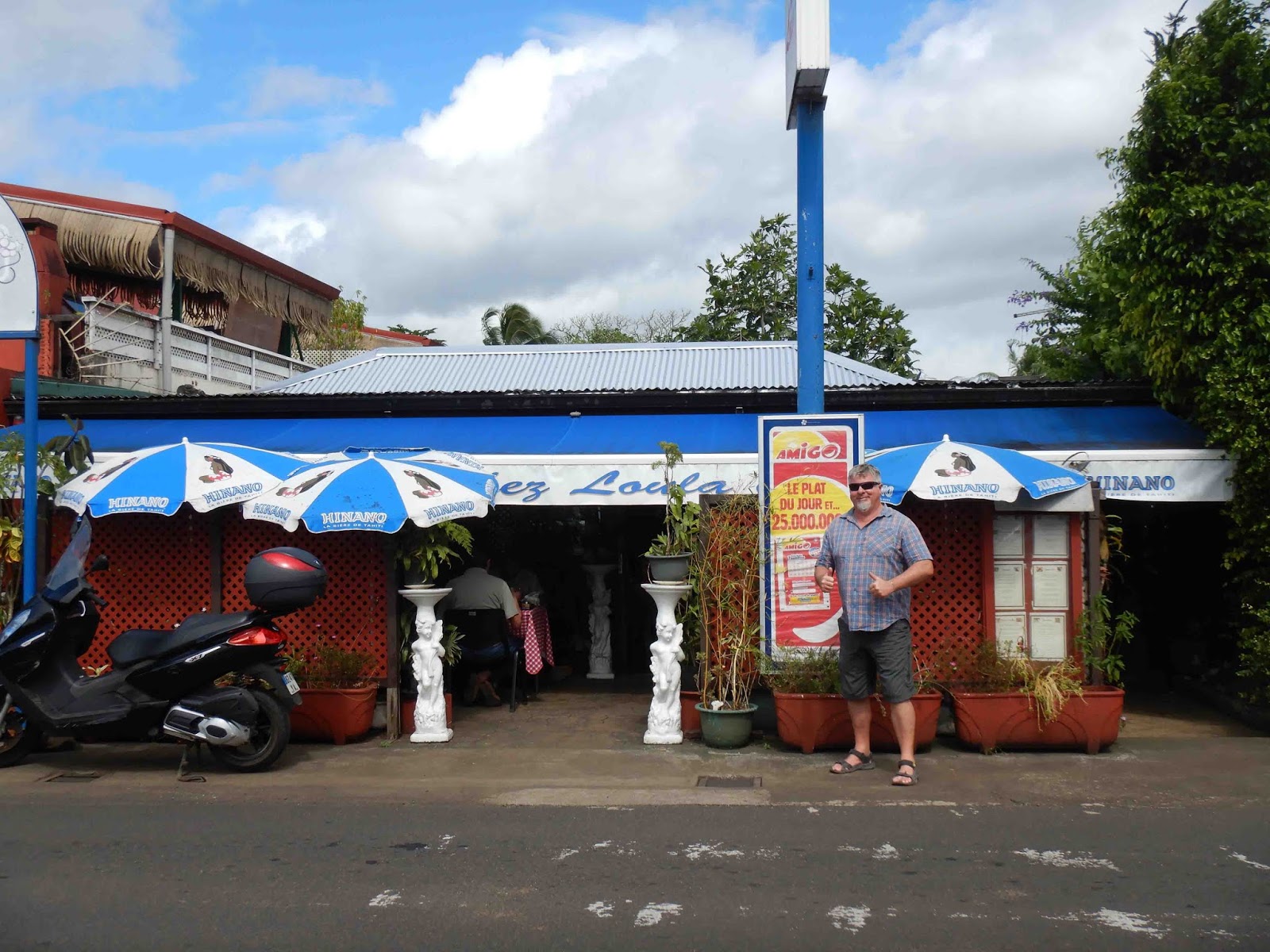
Lunch stop was at a very basic looking place but inside was a pretty good French-style restaurant. John was impressed!


This sideways blowhole was amazing. The noise it made as the spray spurted out was loud and scary if you weren't ready for it.


The famous Venus Point where Captain Cook came to measure the transit of Venus across the sun. It was 250 years ago that Cook landed here.


So that was the end of our French Polynesian sojourn. It wasn't exactly what we expected. It was more of a holiday than a journey of discovery, however we enjoyed our forced downtime.

The Polynesian people are wonderful. They are so friendly and laid back. They are so laid back that flying between islands was a breeze. We could take full water bottles on board and there was no such thing as security checks or queues. It was such a refreshing change. 

I love the colours of this country - the blues and greens of the sea, the lush greens of the jungle and the bright, bold colours of the flowers and clothes.

The islands are simply magical with their stunning seas and drop-dead gorgeous settings. The big downfall though is the expense. It's probably the second-most expensive country we've ever visited, after Switzerland. 

The half-board supplied with the more remote island accommodations was an experience. The food was always good but there was too much of it. As it was too hot to exercise much, our entire use of calories came from snorkelling, which was hardly going to burn up a fraction of what we ate. Consequently, I've gained some very unwanted pounds. We'd better do some serious walking soon!

At every place we stayed, they always gave us a shell necklace. We ended up with quite a collection!


It's now 3am and we're at the airport about to fly to Easter Island. We're really looking forward to this part of the trip.

Au revior to you and to the last of speaking French for a while, thank goodness!

Heather and John.