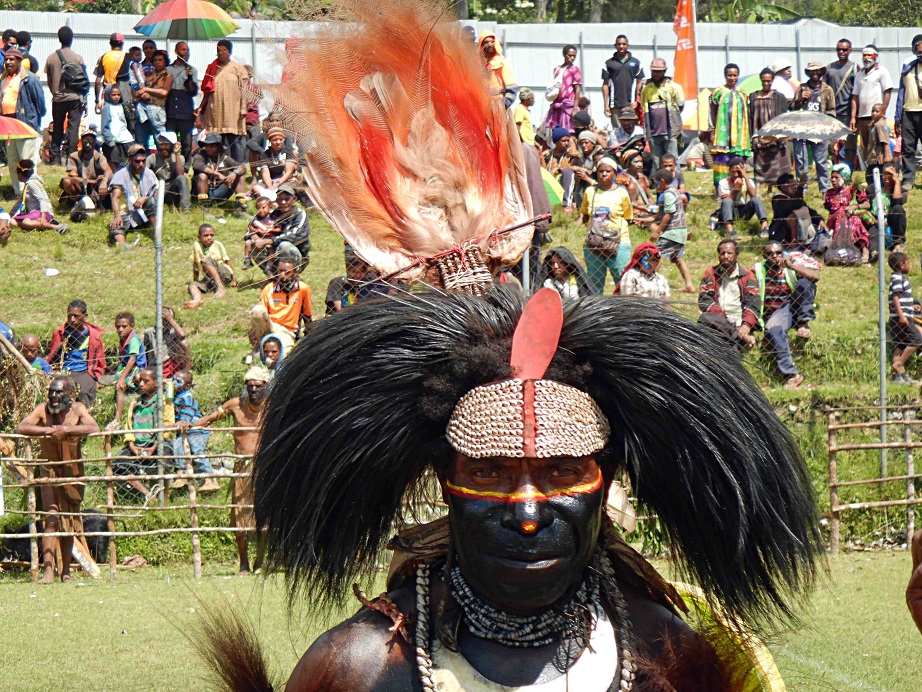
When we first decided to go to the PNG Highlands we thought carefully about how to go about it. There is often tribal conflict here and it's a bit of a dodgy area to visit. We decided to book a nine day tour through a small local tour company - which is basically run by one person. We communicated via email for ages with Pym, the owner, and booked our custom-designed trip. We found him through our Lonely Planet guidebook and the trip was very expensive, thanks largely to the exchange rate, so we could only hope he was up to the job.
The tour didn't start well when Pym forgot to tell his staff that our plane's arrival time got changed and we waited at the airport for a while before anyone turned up. We soon learned that this was a sign of how he operated. Even though we had organised and paid for the trip months in advance, everything was organised from his end at the last minute.
First stop was Magic Mountain Lodge, near Mt Hagen. It was at around 2,400 metres and it was cold! Our room was fairly basic but at least the bed was comfy.
The next day we headed off to the Enga Show, which was in our last blog post. The place we stayed in there was pretty bad. We met five other people there who were also doing a private tour with Pym. Three of them, a Canadian and a Belgian/Chilean couple were not happy with their trip at all. None of us were getting the private tour we had booked - we were all lumbered into cars together. It didn't bother us too much but if definitely bothered some of the others. They complained long and loud about everything. There was also a young American guy staying at the same place who loved Trump, thought the Mexican wall was a great idea and thought that all Americans should have the right to own guns, among other things. I just sat there stunned as some really bizzare conversations flew around the table. We usually have a great time with other travellers but this night was not one of them. We went to bed early to escape the conversation.
We returned to Mt Hagen, this time to The Travellers' Hut, Pym's other accommodation. Pym asked us if we could join with a German couple for the next couple of days. Despite the fact that we had both booked personal tours, we said yes and it turned out to be a great trip.
We headed down the Highlands Highway to Goroka and saw this house along the way. We have no idea what it's about.

Everywhere we go, we have a driver and a guide. Both our guys were from the Mt Hagen area (and therefore that tribe) and we travelled to Goroka where the people were a different tribe. Andrew and Luke were very cautious about our wellbeing and always telling us not to go here or there. As we were driving to Goroka we passed a PMV (a minibus) going the other way. As we passed it, someone threw a full bottle of water out of the window and it smashed into our windscreen with a huge bang. To everyone's astonishment, the glass didn't break. It didn't even leave a mark. Andrew and Luke had a very brief discussion then we turned around and chased the minibus! We caught it, they pulled over, and the guilty person was brought out to look at the non-existent damage that he caused. He looked very embarrassed. When we asked our guys why they chased the minibus, they said the guy had to be shown what he had done. They also said that if we tourists hadn't been in the car there might have been a fight. It was all so bizzare - our guys are so paranoid about our safety yet the only danger we've faced for the whole trip is the danger our own guys put us in! The guilty guy is the one in the blue hoodie and the guy with the white cap was sharpening his axe during the discussion.

En route to Goroka we stopped at our first village sing-sing display. As usual, they had lots of things out to sell. This was a magic bag - a black bag decorated with skulls and other bones of animals. You take it hunting to bring you good luck.

The things they were selling were really interesting but I would never buy anything that an animal had to die just for decoration. Besides, Australian customs would have a fit at all those animal parts! These necklaces are made from pigs' teeth and tusks.

We had read about penis gourds in PNG but this is the first (and so far, only) time we saw them. They are traditionally worn in some areas, with only a belt and a bit of 'arse grass'.

This guy demonstrated a musical instrument. It sounded a bit like a didgeridoo.
The reason we were here though was to see the 'Skeleton Dance'. We were a bit early so watched them getting their body paint ready.

Unlike the sing-sings we saw at the Enga Show, this wasn't a dance - it was more like a play. It told the story of how a young boy is killed by a mysterious beast one day. Soon afterwards, others are killed too.

The beast's costume was great and he was wearing a very impressive penis gourd!

The villagers learned that the beast lived in a cave and they tried to work out how to kill him. They realised that if they dressed as skeletons then the beast would think they were already dead. Sure enough, they manage to kill the beast.
I love how they dragged him out of the cave by the tail.

It was a great performance, just for the four of us. So much effort went into the costumes.

The village we walked through to get there was very pretty. Most villages that we've seen are so neat and clean and houses are surrounded by flowers.

Aluminium cans are recycled in PNG and people collect them and store them on their roofs until they have enough to sell. When they have enough, they lay them out on the road so cars run over them and flatten them!

The five hour drive from Mt Hagen to Goroka was beautiful. When we crossed the Darlo Pass there were kids selling flower headbands. Of course we bought some!

We had a good hotel in Goroka, then headed off to Asaro village the next day to see the famous Asaro Mudmen. We were welcomed with flowers.

Claudia and Thomas, our German travelling companions.

Two men greeted us. Their costumes were great.

As usual, John made lots of jokes and was soon getting on really well with Peter, one of the village men in charge of the show. Peter gave John a 'heart kiss'!


The show began. It was quite simple but interesting. In past times, the villagers' land had been taken over by another tribe. In an effort to scare them away, they coated themselves with clay and made scary clay masks. They waited until there was a mist then crept eerily up to the enemy tribe. The enemy was frightened and ran away. They later worked out that it was a trick and came back but the mudmen still celebrate their brief victory.

This guy appeared to be quite old. The masks weigh about 7kgs, so it was a good effort for him to creep around wearing it for a good 10 minutes or so.


The walls were lined with masks and old ferns draped from every spare space. At the back of the house sat the sorcerer. He wore a skeleton mask and had all his magic pieces in front of him, including human bones. It was all very atmospheric. You would have loved it Courtney!

In front of him sat two young boys with bows and arrows.

A skeleton kept an eye on things.

The two boys in the Spirit House were actually pretty cute! Kids don't go to school on days where they perform for tourists. At first I thought this was terrible but I realised that shows like these are what's keeping these traditions alive. By involving the kids in the shows, they are ensuring that the traditions are maintained.

En route to the next village we passed a place that seemed to be a general store - but it sold coffins too! Sorry for the poor photo - it was taken through the window of the moving car.

The locals bags, called bilums, are used by everyone.

We drove down a rough dirt track and along a beautiful ridge to the next village. The weather tuned a bit wet but it was still very picturesque.

First up they showed us how to cook two different types of meals. A mumu is normally cooked on hot stones under the ground but these guys cooked it above the ground. They layered banana leaves over the hot stones, added the vegetables then a bit of pork (mostly fat) and covered it all with banana leaves, tying it off to form an oven. Water was poured in a hole at the top and it was left to cook for an hour or so.

The other method was bamboo cooking. They stuffed chicken, ginger and greens (which looked very much like indoor plant leaves to us!) into a piece of bamboo, sealed the ends with banana leaves then cooked them over hot coals.

We then walked down to the next village. Again the setting was gorgeous.


Again, the costumes were incredible. I noticed that they were all carefully packed away after the show (except for some of the feathers which were put in the 'sell to the tourists' pile!)

Claudia and I with the troop.

This woman was a real character. She kept hugging me. She wiped paint off her body and wiped it onto my arms. She then hugged me tightly cheek to cheek so her face paint transferred to my face.

In this village, a sky burial is given to the chief when he dies. As there was no dead chief handy, a young boy played the role. Two men carried the 'body' out in a leaf- and moss-lined stretcher.


John with the 'birds'.

They then showed us a few local farming techniques, including how they plant sweet potato. First, use a stick to make a small mound of soil. The soil is rich and loamy so this takes about one minute. Second, break the tip off an existing plant. Third, stick that tip in the mound. And that's it. No watering, no fertilising, no nothing. This land is so rich and fertile that anything grows. They don't water plants!

We then had a go at archery. It wasn't easy! I fell in love with the painted arrows though. It's the only thing I've wanted to buy and sadly, I can't bring them home.

We then got to eat the chicken and greens that were cooked in the bamboo and it was delicious! There was a banquet of sweet potato, taro, cucumber and fruit. While all this was going on, it seemed the whole village had come out to watch us.

Our return walk back up the hill was lovely. John was playing with these kids. I love their smiles!

It seemed that the whole village followed us!

Back in Goroka, we visited a coffee factory. Coffee is big business here and, according to John, the Goroka coffee is very good.

Phew! If you made it this far, you're doing well!
See you soon.
Heather and John